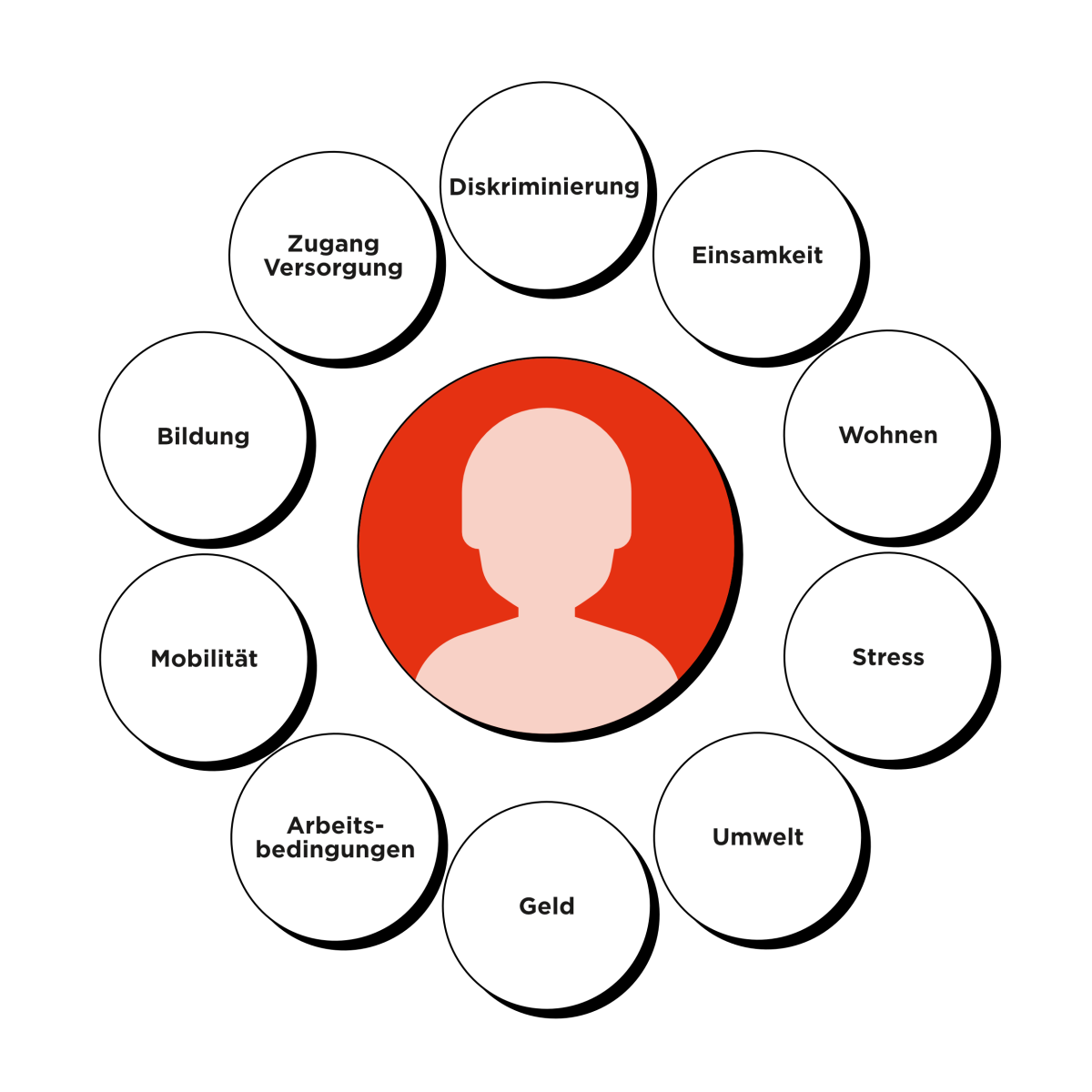
What impact does this have on people's health?
Social determinants of health This means: What has an impact on people's health?
Working conditions
These are examples of poor working conditions:
high time pressure
insecure labour contracts
no co-determination
Poor working conditions cause more stress.
Poor working conditions lead to more sick days.
And are bad for your health in the long term.
What do we need?
We need better working conditions.
For example
Good organisation of work
breaks
a good working atmosphere
a good team that sticks together
Education
A good education is important.
With a good school-leaving certificate, I can get a better job.
I can also get a better job with further training.
With a good education, I know more about health.
And I can prevent illnesses better.
Then I can make good decisions.
Good decisions for me and my health.
What do we need?
good educational opportunities for everyone
free educational programmes
educational programmes on health and prevention
easy access to these educational programmes
Discrimination
Discrimination means that a group or person is put at a disadvantage.
Some people experience discrimination on a regular basis.
They then have a higher risk of illness.
These can be mental or physical illnesses.
Discrimination can cause fear, anger, frustration and then chronic stress.
Chronic stress means permanent stress, the stress does not decrease.
Chronic stress weakens the immune system.
Then the risk of these diseases increases:
High blood pressure
heart disease
depression
What can I do?
What can we do together?
Do not tolerate discrimination
Stand up against discrimination
Support those affected
Information and education
Promote diversity
Keeping together
Loneliness
Loneliness can make you mentally and physically ill.
Loneliness increases the risk of depression.
Loneliness increases the risk of cardiovascular disease.
Lonely people can die earlier.
What can I do?
What can we do together?
Caring for acquaintances, friends and family
Neighbourhood help
Everyday help
Joint activities
Create meeting places
Money
Money has a major influence on health.
Poor people are more likely to feel unwell.
Poor people are more often chronically ill.
Chronically ill means permanently ill.
Poor people die earlier.
If I have more money, I have more financial security.
If I have more money, I have less stress.
Less stress is good for my health.
What do we need?
We need good working conditions.
And more co-determination at work.
The trade union can help with this.
We also need a good welfare state.
And easy access to social benefits.
We need more counselling for social benefits.
That protects against poverty.
That also protects against social exclusion.
Then people's mental and physical health will be better.
Mobility
Mobility here means: How do I get from one place to another?
It's about local public transport.
These are trams, trains or buses.
Are they easily accessible for everyone and do they run frequently?
Are they not that expensive?
If I can get to trams and buses easily, I have more time.
If I can get to trams and buses easily, I have less stress in my everyday life.
Good cycle paths and footpaths are also important.
Without local public transport, people can't get to many places.
Especially older people.
Or socially disadvantaged people.
Then these people are isolated.
That means they are often alone.
Mobility is very important for people's health.
Everyone should be able to reach all places easily.
What do we need?
Free local transport
well-developed local transport
good cycle paths and footpaths
Stress
Stress is a natural reaction of the body.
But if I am permanently under a lot of stress, it can make me ill.
Constant stress also means chronic stress.
Chronic stress weakens the immune system.
This increases the risk of these diseases:
High blood pressure
Heart disease
depression
People have different levels of stress.
People with low incomes often have more problems and more insecurities.
Problems and insecurities cause more stress.
What do we need?
Social cohesion
Protective factors against permanent stress
Protective factors are, for example
fair distribution of income
fair distribution of living space
Environment
Our environment is very polluted.
There are harmful substances in foodstuffs.
There are harmful substances in everyday objects, e.g. harmful substances in furniture or plasticisers in toys.
There are also health problems caused by
Fine dust
noise
UV radiation
These pollutants and stresses can make you permanently ill.
They can be the cause of
Asthma
High blood pressure
cancer.
Poor people are more affected by pollution.
This means that the health of poor people is more at risk.
What other environmental problems are there?
There are differences between parts of the city.
Some parts of the city have many large roads and a lot of car traffic.
This has an impact on people's health.
Some parts of the city have less public transport.
Some places are difficult to reach.
Especially for people who don't have a car.
Some parts of the city have few places for socialising and leisure.
This has an impact on social cohesion.
What do we need?
Good urban planning for people.
Places for recreation in all parts of the city.
Protection of residents from harmful environmental influences.
Housing
A good home is important for health and for the quality of life.
But not everyone has a good home.
This puts a strain on people and causes them stress:
little space in the home
Fear of having to give notice
High rents
Noise in the home or outside
What do we need?
affordable housing
good urban planning, i.e:
- Places for recreation, play and leisure
- places for socialising- good local public transport
Good urban planning is important for social interaction.
Access to healthcare
Access to healthcare is different for different people.
There are several reasons for this.
These are examples:
There are fewer general practitioners in rural areas.
There are fewer specialist doctors in rural areas.
People in rural areas have to wait a long time for an appointment.
Or they have to travel long distances to another town.
Some people have a language barrier.
Some people have a mother tongue other than German.
Access to healthcare is also more difficult for these people.
That is also important:
Healthcare is more than just curing illnesses.
Healthcare is also about prevention.
What do we need?
Good healthcare everywhere
Services close to where I live
services in several languages
easy access to the services
multi-professional collaboration, i.e:
Employees with different professions work together.
For example, health professions and social professions.
This allows people to receive better care.