Solidarity-based health centres
Our concept
Healthcare, a meeting place and a starting point for transformative processes - we combine all of this in our centres, the polyclinics and solidarity health centres. These centres are embedded in social spaces, neighbourhoods, districts or counties and thus combine local care with aspects of social inclusion and participation. As an association, we pursue the goal of establishing solidarity-based health centres as an independent component of the healthcare system in the long term. Our members are responsible for these centres, some centres are already in operation, others are in the process of being set up.
The concept of solidarity-based health centres
Our concept was developed on the basis of various scientific concepts and models. Inspired by various international models and our own experiences with the German healthcare system, we have developed a model of solidarity-based healthcare centres. In our centres we combine health care, community work and research.
The most important models on which we have based our concept are the bio-psycho-social model of health, the social determinants of health and the "Health in all Policies" approach. The unifying element of these concepts is the comprehensive view of health.
Place for care
Our individual health is best viewed from three perspectives:
the physical,
the mental
and the social.
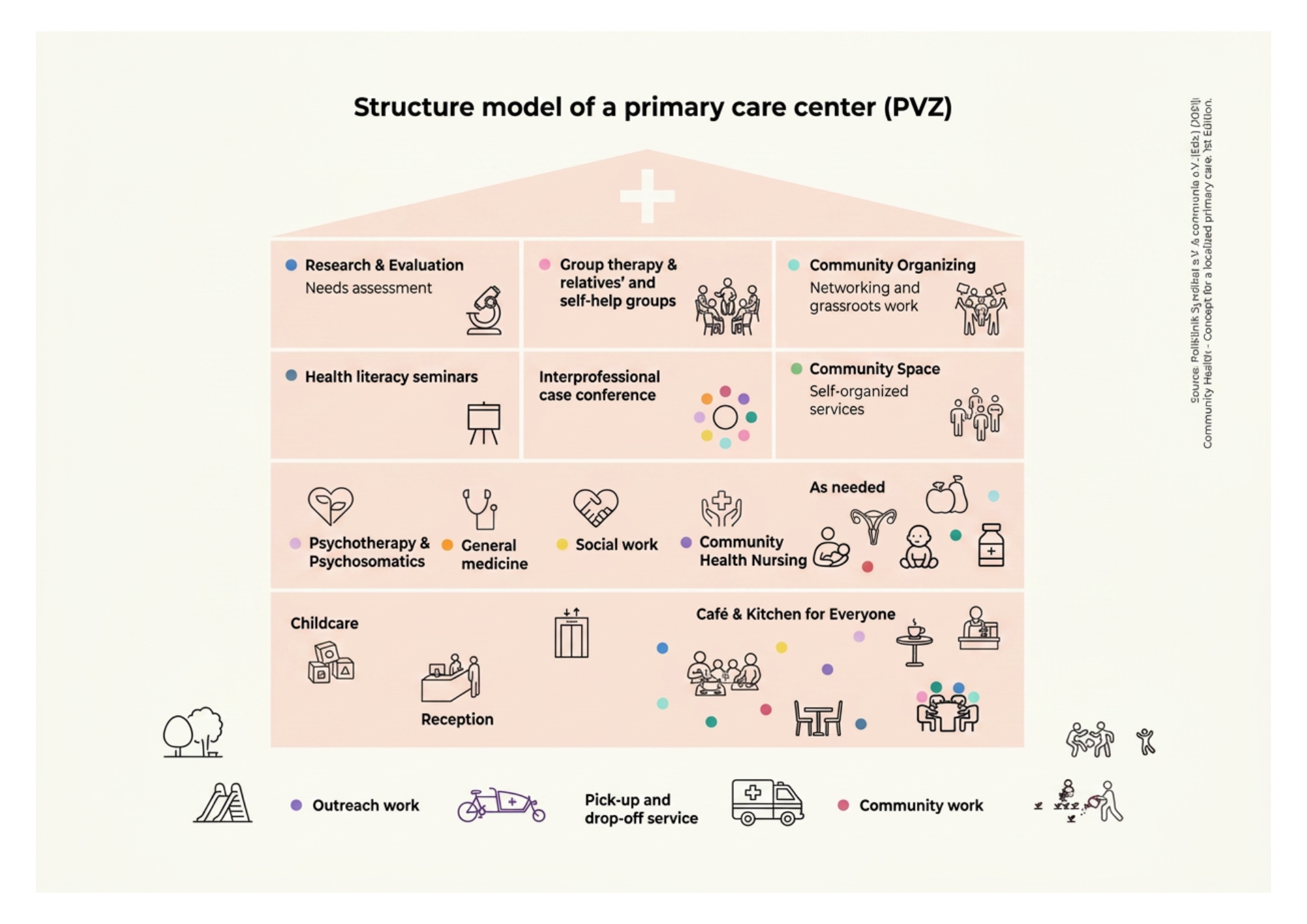
We focus on these three aspects as part of our outpatient primary care. In our basic concept, this includes general medical care, psychological counselling, social counselling and community health nursing. With these four professional services, we offer a contact point for many general health problems of local people. Important features of our work are interdisciplinary cooperation between the professions working there and a collective, solidarity-based and hierarchy-sensitive way of working.
A place for encounters and transformation
Our individual health is significantly influenced by the conditions in which we live. These conditions determine our health more than our individual behaviour. In order to change these conditions, the influence of decisions on our health must be considered at all political levels. This is also known as situational prevention, which we implement in the areas of community health nursing and community work. As part of community work, a wide range of programmes are implemented that create community, promote participation and involvement and thus work on health issues together with local people. This work is the starting point for transformative change processes.
Place in the social space
Our centres are part of the social and solidarity infrastructure and always relate to the space around them. What this space looks like, how big it is and how many people live there depends on the local conditions. It can be a neighbourhood, a district or a county - the important thing is that it is recognised and lived as a social space and can therefore provide a framework and point of reference for the people who live and work there.
The basic concept and beyond
In our concept of a multi-professional district health centre, we describe what we call our basic concept. By this we mean that a solidary health centre should include at least these services and professions. At the same time, we are aware that there is much more to good and comprehensive healthcare: for example, paediatric and gynaecological practices, midwives, as well as physiotherapy and occupational therapy services. Some of this is already being implemented in some centres. From our perspective, it would be desirable to create health centres in which a wide range of health and medical professions can provide exactly the services that are needed locally on an interdisciplinary basis.
Implementing the concept on site
Even though we as an association pursue a uniform basic concept for the centres and have formulated some minimum requirements, the existing centres differ in many respects. There are two main reasons for this:
the local conditions
the organic development of the centre
Consideration of local conditions
Even if we are convinced that our concept works everywhere and represents an improvement in outpatient care, it still always needs to be adapted to local conditions. Various factors play a role here:
Needs and demographic trends in the social environment
Existing services and structures of other organisations
Political and legal situation
Organic development in the organisation
In addition to the factors mentioned above, health centres generally develop organically from self-organised groups. No centre has yet opened and been able to fully implement the concept from the outset. The development of the centre depends on the people involved, their qualifications and professional backgrounds, but also on the financial resources. Which funding or other resources can be obtained has a major influence on the development of the various areas of the programme.
Historical and international role models
The concept of local care centres has been implemented internationally for years. However, the German healthcare system lacks such a component, although it already existed in the GDR with the polyclinics. However, these were not incorporated into the system at the end of the GDR.
In countries such as Belgium, France, Sweden, Ethiopia, Canada and several others, there are similar concepts of health centres. In some cases, these are an integral part of state healthcare provision.
The polyclinics in the GDR were medical facilities in which all specialities of outpatient primary healthcare worked together under one roof. GPs, gynaecologists, dentists and other specialists practised virtually next door to each other. This approach offered many advantages for both patients and clinic staff. For example, patients had short distances between different doctors. In turn, the doctors were able to work together more easily on a multi-professional basis or share medical equipment.
As the Polyclinic Syndicate, we are taking up the approach of multi-professional work in close proximity. At the same time, we are aware that there were shortcomings in the polyclinics of the GDR. As a result, we have further developed the concept of the polyclinic: In our health centres, physiotherapists, social workers, psychologists, community health nurses and carers work alongside the medical staff. This means that in addition to multi-professional medical care, neighbourhood work, self-organisation, participation and relationship prevention also take place in our outpatient clinics and play a central role.